Equinox and solstice dates 2027, to the minute in AEST and UTC
The four turning points of the 2027 year are exact moments, not whole days. The Sun reaches 0 degrees of Aries (the March equinox), Cancer (the June solstice), Libra (the September equinox) and Capricorn (the December solstice) at an instant that astronomy can pin down to the minute. We computed all four in the Crohamhurst app, then checked them against an independent official source.
Market astrologers call these the cardinal ingresses and treat them as a calendar of moments to watch. The dates themselves are not opinion. What a market does on or after them is a separate question, and we come back to it below.
The four 2027 dates
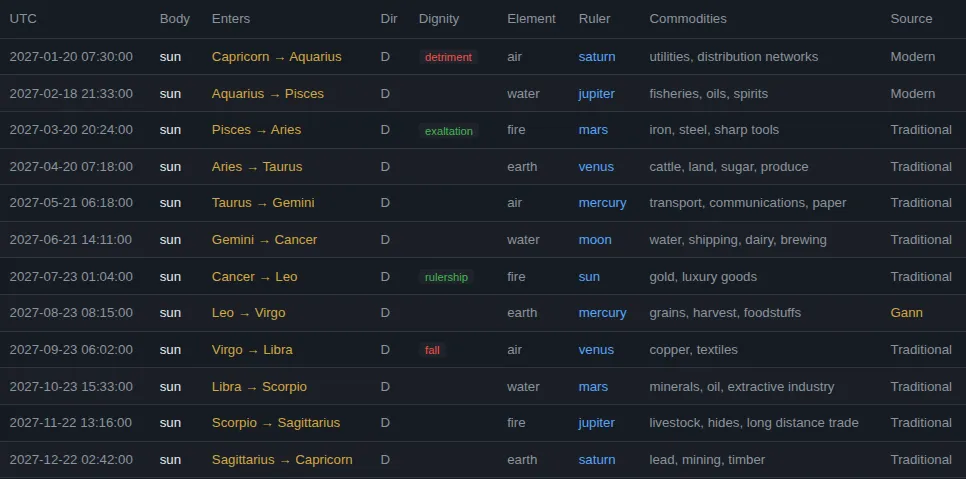
We ran the app's Ingress module for the Sun alone across 2027. Brisbane time (AEST, UTC+10, no daylight saving) is worked out by adding ten hours to the UTC time from the app.
| Moment | UTC | AEST (UTC+10) |
|---|---|---|
| March equinox (Sun enters Aries) | Sat 20 March, 20:24 | Sun 21 March, 6:24 am |
| June solstice (Sun enters Cancer) | Mon 21 June, 14:11 | Tue 22 June, 12:11 am |
| September equinox (Sun enters Libra) | Thu 23 September, 06:02 | Thu 23 September, 4:02 pm |
| December solstice (Sun enters Capricorn) | Wed 22 December, 02:42 | Wed 22 December, 12:42 pm |
Sydney, Melbourne, Canberra and Hobart observe daylight saving on 22 December, so the local clock there reads 1:42 pm (AEDT, UTC+11). Queensland, the Northern Territory and Western Australia do not shift. Perth is UTC+8, so the December solstice is 10:42 am there.
In the Southern Hemisphere the names flip. The March equinox starts autumn in Australia and the September equinox starts spring. The June solstice is the shortest day of the year here, and the December solstice is the longest.
What the app did
The form takes two dates, a row of body chips and a frame. We set 1 January to 31 December 2027, deselected everything except the Sun and kept the geocentric frame. One year costs 2 compute units.
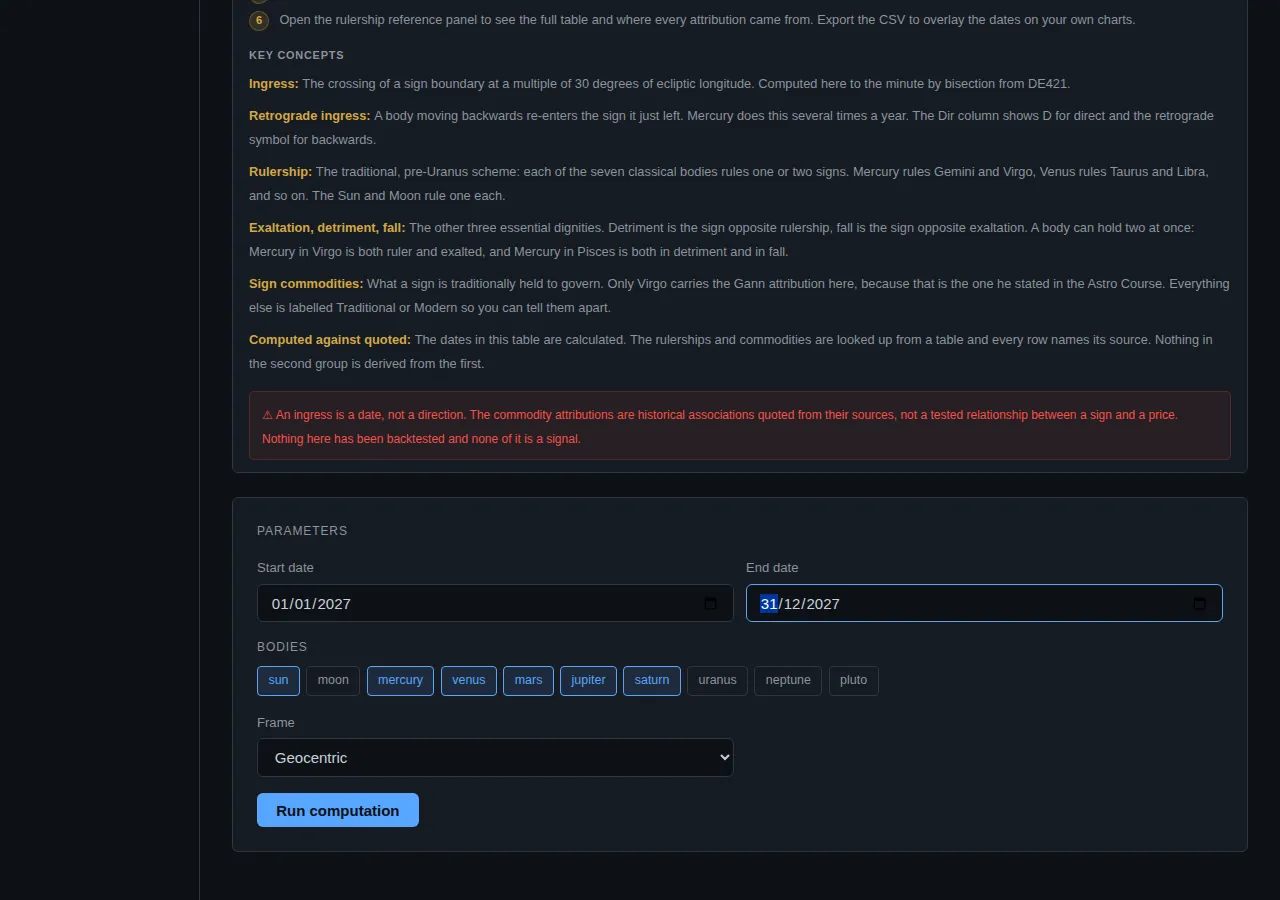
The module reads the Sun's ecliptic longitude each day from the JPL DE421 ephemeris, spots the day a 30 degree sign boundary is crossed, then narrows it down by bisection to a 60 second window. A full year of sign crossings came back in a few seconds. That is twelve rows, one per sign, and the four cardinal ones are the rows for Aries, Cancer, Libra and Capricorn.
Checked against the US Naval Observatory
An app computing its own answer is not a test, so we fetched the US Naval Observatory's published 2027 seasons on 14 November 2026. Its times, in UTC, were:
- March equinox: 20 March, 20:25
- June solstice: 21 June, 14:11
- September equinox: 23 September, 06:02
- December solstice: 22 December, 02:42
Three of the four match the app to the minute. The March equinox differs by one minute: the app gives 20:24 and the Observatory 20:25. We think this is rounding at the minute boundary, since the app reports the first minute after the Sun crosses and published tables round to the nearest minute, but we have not confirmed which convention the Observatory uses. Either way, the agreement is within one minute on all four dates. For planning, you can treat them as exact.
How long each season runs
Subtracting one moment from the next gives the length of each season in the Northern Hemisphere naming, using the UTC times above:
- March equinox to June solstice: 92 days and 17 hours 47 minutes.
- June solstice to September equinox: 93 days and 15 hours 51 minutes.
- September equinox to December solstice: 89 days and 20 hours 40 minutes.
The seasons are not equal because the Earth's orbit is slightly elliptical and it moves faster when nearer the Sun. The Observatory lists perihelion on 3 January 2027, so the shortest span falls around the December solstice.
Why market astrologers watch them
Practitioners read these four moments in a few traditional ways. These are conventions from the literature, not results we have tested:
- The seasonal chart. A chart is cast for the exact moment the Sun enters a cardinal sign and used as a frame for the following three months.
- Dignity. The app marks the Sun as exalted entering Aries and in its fall entering Libra, from the traditional rulership tables. The Cancer and Capricorn entries carry no dignity label for the Sun.
- Other planets. Astrologers look at where the other planets sit at that instant and which aspects they make.
The app tells you plainly which columns are computed and which are quoted. The times and dignity badges are calculated. The commodity column is a lookup labelled by source (Traditional, Modern or Gann), and none of it has been backtested.
What can be tested, and what the research says
Where peer-reviewed research finds a real calendar effect, it is usually tied to the seasons and daylight rather than to a sign. Kamstra, Kramer and Levi (2003, American Economic Review) tied returns to the daylight cycle, with the Southern Hemisphere six months out of phase. That makes the solstice and equinox dates a natural set of boundaries to test, because they are the exact turning points of day length. Our post on the daylight and seasonal affective disorder effect covers that study.
A published effect is an average over many years, not a signal for any given week. Testing an ingress idea is straightforward, and the app makes the date side quick:
- Write the rule first, with the market and date range, before you look at prices.
- Pull the cardinal dates for as many years as you like. The Ingress module takes up to ten years in one run.
- Compare your measure on those dates with the same measure on ordinary dates, as a luck baseline.
- Keep the sample size in view. A decade has forty cardinal ingresses, which is a small sample.
Our ingress how-to walks through a worked example for the March 2026 Aries ingress, and the ingress guide covers every field in the module.
What this does and does not give you
It gives you four dates for 2027 that are right to within a minute, in the time zone you trade in, and a quick way to produce the same for any other year from 1900 to 2050. It does not give you a direction. An ingress is a date, not a forecast.
This is research and education, not financial advice.
Try it yourself
Open an account at /app/register, choose the Ingress and rulership module and run your own year. Then read the ingress guide for the full walkthrough, including the CSV export for overlaying the dates on your own charts.
Crohamhurst computes the Square of Nine, Bradley siderograph, planetary ephemeris, cycle scans and historical analogs from your own price data, in your browser. Plans start at $49 a month.
Create an account