Planetary Aspect Finder: Find the Jupiter-Saturn Conjunction of 2020 in 5 Minutes
A planetary aspect finder lists the dates two planets reach an exact angle to each other. In the Crohamhurst ephemeris you pick two planets, the angle and a date range, and the app returns each date the angle was exact. For Jupiter and Saturn in 2020 it returns one date, 21 December 2020, at a separation of 0.03 degrees.
What an aspect is
An aspect is the angle between two planets as seen from Earth, measured along the ecliptic (the Sun's path across the sky). A conjunction is 0 degrees, so the planets sit at the same longitude. An opposition is 180 degrees. A square is 90, a trine 120 and a sextile 60.
Traders who use planetary cycles build calendars out of these dates. Whether markets care is a separate question, and the app does not claim they do. What the ephemeris does is the astronomy, accurately. It uses the JPL DE421 ephemeris through the Skyfield library, a standard source of planetary positions. Our post on aspect precision explains the maths and the checks we ran.
Step by step: do it in 5 minutes
This costs 2 compute units, out of the Free plan's 50 a day.
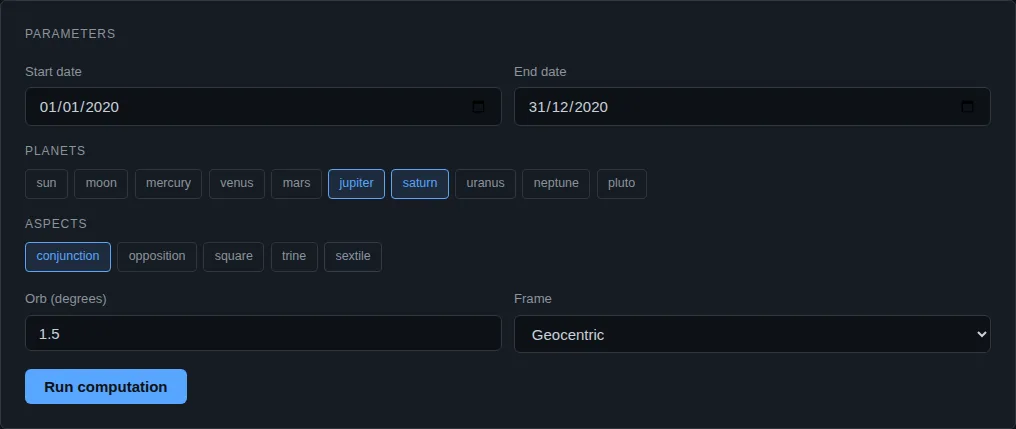
- Sign in at crohamhurst.app and open the dashboard.
- Choose Ephemeris timelines.
- Set Start date to 1 January 2020 and End date to 31 December 2020.
- Under Planets, click jupiter and saturn so only those two are highlighted.
- Under Aspects, click conjunction so only that is highlighted. Leave orb at 1.5 degrees and frame on Geocentric.
- Press Run computation.
How to read the result
The app returns a timeline and a table. For this run there is exactly one event.
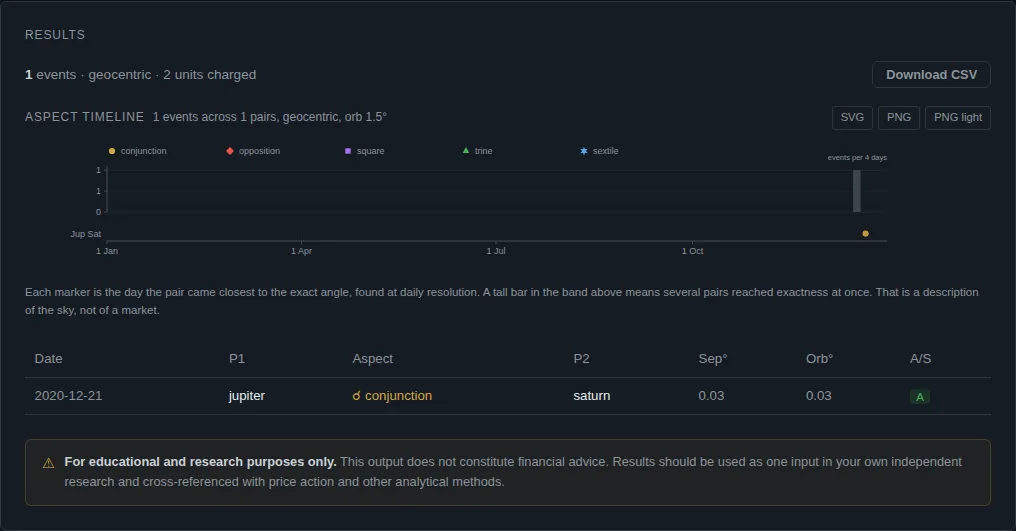
| Date | Planet 1 | Aspect | Planet 2 | Separation | Orb | A/S |
|---|---|---|---|---|---|---|
| 2020-12-21 | jupiter | conjunction | saturn | 0.03 degrees | 0.03 degrees | A |
Four columns matter.
- Date is the day the pair came closest to exact, found at daily resolution.
- Separation is how far apart the planets were on that day, in degrees of longitude. 0.03 degrees is very tight.
- Orb is the deviation from the exact angle. For a conjunction it equals the separation.
- A/S is an applying or separating flag. Do not lean on it. Our ephemeris guide explains that at a detected minimum it is true by construction for almost every event.
There is one event because Jupiter and Saturn meet about once every 20 years, so a year-long search finds at most one.
What to do next
Widen the question. Try the same two planets with square and opposition over several years and you get the rest of their cycle. Try Mars and Saturn for a faster pair. If you are using the Free plan, longer ranges and more pairs cost more units, so check the cost table in the getting started guide first.
Then do the step the app cannot do for you. Put the dates on your own price chart and look. If you want to turn that look into a test, write the rule down before you look, as we do on our tracked calls.
Common mistakes
- Using a tight orb on the Moon. The Moon moves about 13 degrees a day, so with a 1.5 degree orb and daily samples it can pass through an aspect without being caught. Use 7 degrees or more.
- Reading the A/S column as a signal. It is true by construction for almost every event, so it carries little information.
- Mixing frames. The default is geocentric, which is positions as seen from Earth. A heliocentric run gives different dates for the same pair.
- Treating the date as the whole event. The orb tells you how close the planets were on the day, but a slow pair like Jupiter and Saturn stays near each other for weeks either side.
Check each of these before you build a calendar from the results.
What this does not tell you
The ephemeris tells you where planets are. It says nothing about what a market will do on those dates. A date list is a description of the sky, and any link to prices has to be tested separately.
Questions people ask
How do I find planetary aspects for a date range? Choose the planets and angles you care about, set the dates and run the ephemeris. The result lists the date each pair reached the angle.
What orb should I use? The default 1.5 degrees works for slow outer planets. For anything involving the Moon, use at least 7 degrees, because the Moon moves fast enough to pass through an orb between daily samples.
Is the ephemeris free? Yes, within the Free plan's 50 compute units a day. This run uses 2.
Does it show Pluto and the Moon? The planet picker includes the Sun, Moon, Mercury, Venus, Mars, Jupiter, Saturn, Uranus, Neptune and Pluto.
General information only. This is not financial advice. Past patterns do not guarantee future results. Consider your own circumstances, or speak to a licensed financial adviser, before making any investment decision.
Crohamhurst computes the Square of Nine, Bradley siderograph, planetary ephemeris, cycle scans and historical analogs from your own price data, in your browser. The free plan needs no card.
Create free account